Tuesday, April 22, 2014

Moustached reed babblers


I have been watching reedlings with a friend at a site in the south east for the last few years, and after a long winter with almost 6 months of no sightings, recent weeks have been incredible. This is the first spring that I have had time to spend searching for and watching pairs, and although difficult to access large areas of reed bed, 2 nests and atleast 4 pairs have been pinned down in one small area.
Reedlings are only a recent colonist in Ireland, spreading from 4 at one site, found in November 2010 to several pairs at 4 sites in 2013. One of these sites was extensively flooded this winter with sea water and so far only singles have been seen this spring. Fingers crossed the birds havn't moved far. Two small colonies were established in the late 70's, but both had disappeared 5 years later with various reasons given for their demise. Depending on who you ask, fluctuating water levels, successive cold winters, habitat destruction and low-numbers and a small gene-pool have all been blamed.
 Apart from 2 spring males in 1990, it had been a gap of almost 30 years upto their recent appearance. 


 Sketches of my first beardies from Lake Tata in Hungary, May 2004.

 Male Reedlings, Ring Marsh, March 2012.
 Juvenile male reedling, Tacumshin Lake, July 2012.
 Adult female, Tacumshin. February 2012.

After great views of juveniles and family parties upto late September 2013, the birds went quite and calls were only heard from 2 sites, about 1 km apart on January 2nd 2014. It wasn't until early April that birds became more vocal and another week before I finally saw my first of the year, a male briefly perched in the open. 
The following week things really started to get going with 2 males and a female showing well by a channel. By the end of the day, a single male and female appeared paired up and settled into a spot in the reeds. It was only on the next visit was the nest site was pin-pointed, about 10 feet from the channel on dry ground in a dense clump of reeds and grass. Leaving a friend watching these I tried to pin down and few more and quickly found a pair at a site used last year, then another close by. Between all these pairs, single calls were heard and it was difficult to know how many birds were around. A final pair was found at the end of the channel which hosted the first pair, with another bird heard further in, away from all the others! A possible fifth pair were found a few days later, but it is so difficult to establish territory sizes and ranges.

Pair preening each other after leaving the nest, April 2014.
At one site, pro-longed views of the female thought me a valuable lesson in estimating numbers. The distintive 'pching PCHING pching pching' calls I had, to date attributed to pairs or small flocks were all coming from her! Several times I have heard this call, and even early this year I have assumed a small flock were close by. Little wonder I didn't see any!
After calling, she was soon joined by 2 males and a mouse like chase began through the reed bases at lightening speed. A clucking 'tuk tuk tuk' call was heard but hard to know which bird was making it. It was similar to juvs but faster and deeper, the female ended the chase by flying towards me and landed within feet. A brief skirmish between the males with one given his marching orders before the female dropped back down to join the victor. Fluttering her wings infront of him, they mated deep in the reed bases.

 Female checking me out while the males fought.
This pair seem to be nesting close to the channel in some dense nettles. All the pairs seem to be along wider channels, atleast 10 feet across, this could be just that these are the easiest areas locate them being able to view from a distance. There are several narrower channels I have yet to hear birds in.
This is the first time I have seen females well in spring and I have been struck by their dark bills. I had passed of female types with darkish bills last summer as moulted juvs but it clearly seems to be a summer feature. The eyes also seem darker in summer than in winter, and as pointed out by a friend, a thin black ring of 'mascara' is present also. I can't find reference to these features online and they are not mentioned in any field guides I have.
Female reedlings, 2014.
Ad breeding female,  two non-breeding and a juvenile female.

Breeding female,dark bill, darker eye and 'mascara' eye ring.

Adult non-breeding female.
Yellow bill and eye and no black eye ring.

Male reedlings, ad, moulting and juvenile.
The black under tail coverts are moulted in quickly, the face gets a little swarty, before the grey head moults in, starting with the forhead.
 Juvenile males, August 2013.
 Juvenile male, Tacumshin, July 2012.


Adult males, just stunning!

I can't wait to get back down and see what the next visit brings.

Friday, January 24, 2014

Pacific Diver

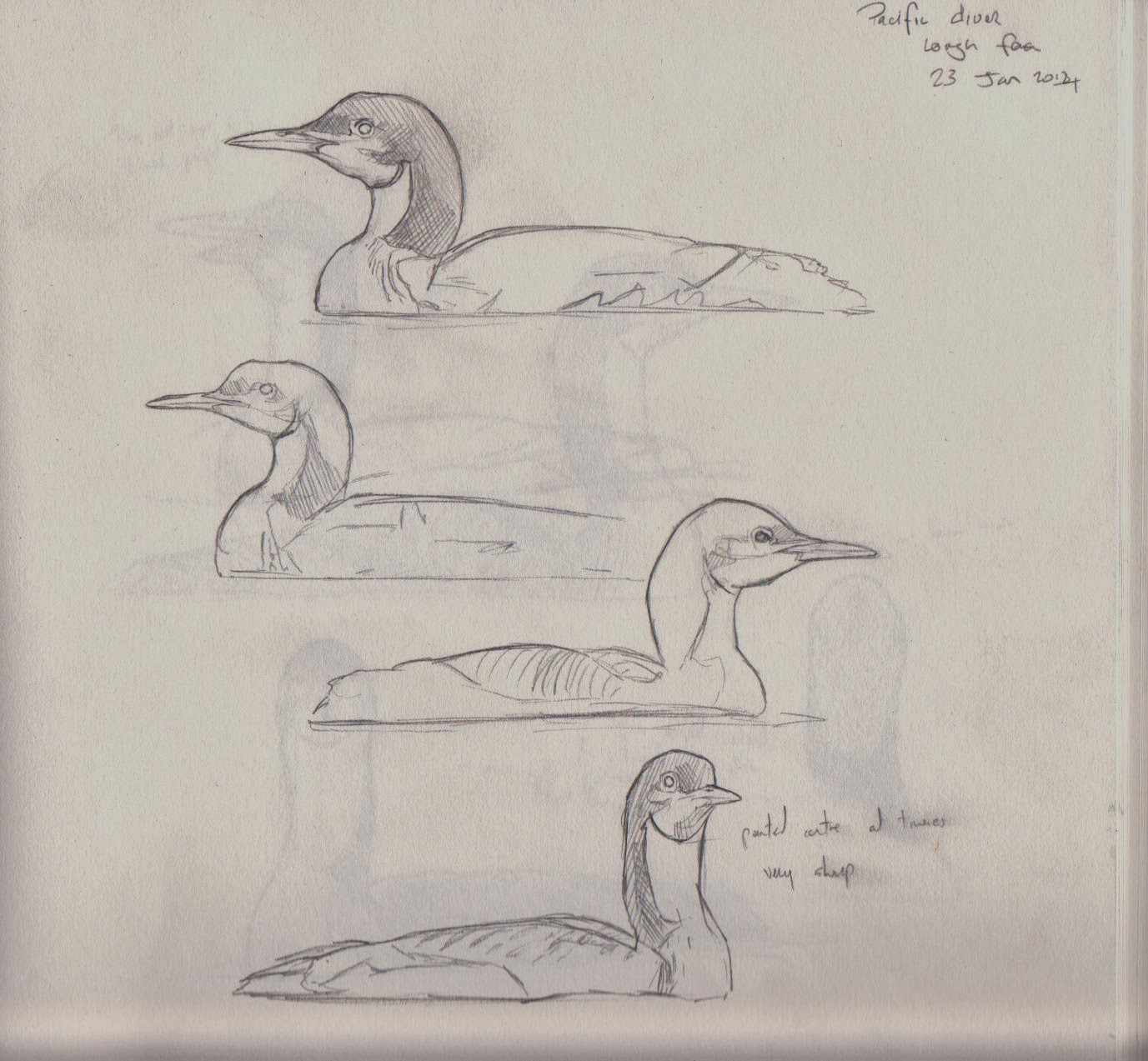
 I travelled upto Lough Fea in Co. Tyrone yesterday to look for the pacific diver found recently. First to arrive, we enjoyed fantastic views early on before it became a little distant as more birders arrived. Later in the morning it was showing really well again on the western shore line with the strong sun behind it.
 The throat strap was very distinct and the flanks were usually all dark, but as it relaxed it often showed long white 'tufts' along the flanks. The bill was also a little longer than I was expecting for a pacific but certainly not out of range for one.
 I found the mantle feathers difficult to note, every shift in position and the four seasons of weather we experienced changed their appearance. They were quite plain with a subtle paler tip/fringe, clearly adult type. At times white spots on the coverts could be seen as the scaps were lifted while it preened.

 A few illustrations of the bird today using photos and sketches.
 Nice obvious throat strap, very distinct from all angles and lights. Much easier to make out than on the distant bird at Doorus pier in Co. Clare in 2010.
The vent strap was visible at times as it preened, but never seemed to be complete, it was definately thinner in the centre broadening out to the thighs.

Finished the day off at Giles' quay near Dundalk with 16 twite showing down to a few feet for over an hour by the pier. Some of the best views I have ever had and hopefully I will get up there again next week.

Thursday, January 16, 2014

Ross's gull

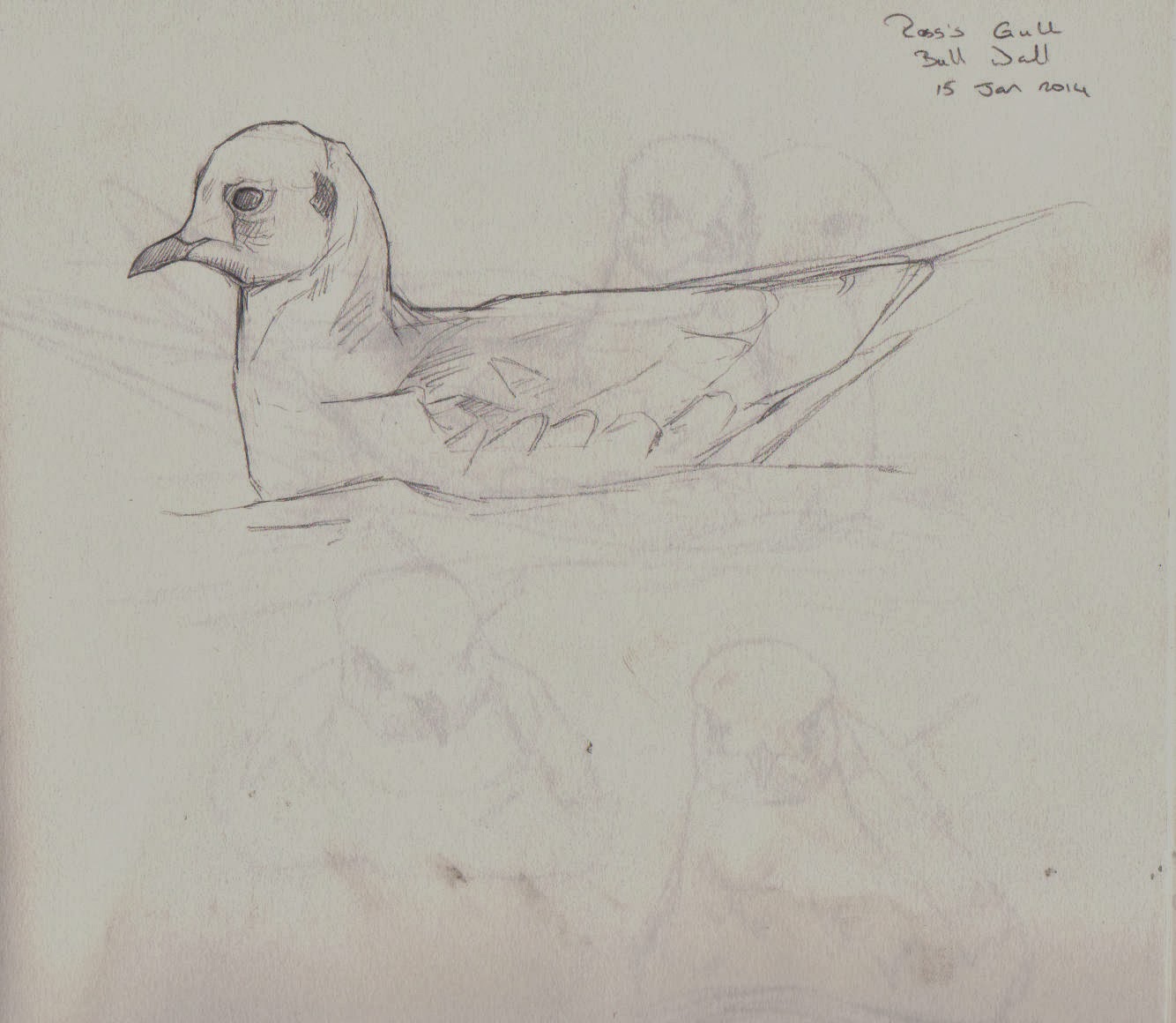
I had just finished some work and about to make some lunch yesterday when I got a text about an adult ross's gull feeding along the bull wall in north Dublin. I threw everything into the car and went hungry as I made my way through lunchtime traffic. As I pulled up the bird was feeding just feet off the rocks below and for the next few hours I enjoyed incredible views as it fed along the causeway.


 The bird was feeding close in to the shore for the whole afternoon, but would regularly get up and fly short distances before settling down again. It remained on show until I left in near darkness.


 I worked on some paintings of the bird this morning, have a few more to finish off yet.
While on the causeway, the 6 snow buntings that had been in the area all winter flew in and landed close by, much to the annoyance of a small group who went off in search after seeing the ross's gull!

Tuesday, January 14, 2014

More gulls

 The adult ring-billed gull returned for atleast it's third winter and was showing well in its usual spot today. I was there early enough this morning and despite throwing out a loaf of bread that brought the rest of the gulls down, he sat still glaring down on me. 

Not impressed with my fresh white bread.

Sunday, January 12, 2014

Ivory Gull

 I travelled down to wexford on saturday morning in the hope that the ivory gull would still be around. It was still dark when we arrived but we were told it had already been seen flying below the carpark. It took a short while before it was located feeding on carrion and viewable from a muddy field. For the next 4 hours we enjoyed incredible views of this stunning bird. After feeding for all of this time, it shat, preened a little in the water and then flew into the centre of the lake where it continued to preen.

 It turned out that the gull was feeding on a porpoise, quite an oddity in a land locked coastal lake! It just shows how powerful the recent storms have been to push this over the dunes and into the lake.


I didn't spend much time sketching the bird, and regret not having made more of such a great opportunity.

Friday, January 10, 2014

Local gulls


During the week news broke of a caspian gull photographed in a nearby park a few weeks ago, I didn't think it would be still around but I checked a few of last years gull spots. No sign of the ring-billed yet, but I'm sure it will turn up. The following day came news that it was still in the small urban park and within 20 minutes I was watching it. There have probably been less than 15 caspian gulls in Ireland, so to have one so close, and as it turned out, so tame was great.


 It was quite a dark mantled second winter bird, very advanced in moult and instantly stood out.


 With it being so close I was able to go up and see it a few times, and I hope to get up again soon. Tomorrow I'm hoping the Ivory gull in wexford stays another day.

 I was probably a little late for the caspian today, no sign of it on the usual pond so I tried another Park. Plenty of common gulls, 2 great black backs and a single adult lesser black back. I spent a bit of time sketching a young common until the rain arrived.

 This female merlin posed nicely for me in Cahore last week. With short eared owl, peregrine and a hen harrier in the same area I didn't know where to look!

Thursday, October 24, 2013

Dusky warbler, I'm having it!

While checking a garden on Aranmore a few weeks back I heard a few lesser throat like chak calls. With out really time to think about the identity, a small warbler popped up infront of me. I could only see the head but I immediately thought dusky warbler. After a stand off, I tried to move slightly to see the whole bird, but it dropped out of view. I tried a chakking a bit and the bird popped up again, but once more, only the head was visible. While waiting for it to re-appear, I scribbled down some notes. Unfortunately, the bird never showed again, only calling a few times from thick cover a few hours later.
It was one I thought would probably be best forgetting about, but I felt the distinctive head and call combined were enough to work with. The notes I scribbled down about the super being sharply defined and ending infront of the bill match all my notes and photos of dusky from Asia, plus everything on a google search. Chiffchaffs' super is more diffuse and usually extends over the the bill, plus the call is completely different. Raddes', although never really thought of with this bird falls down on these features also.

 Dusky warbler from Rudong in May 2013. The head is a little blurred but the well defined super is still obvious. It is not a feature mentioned in any field guides I have, but is in the advanced bird id handbook.
Its good enough for me and I'm having it!


Chiffchaff from Tory Island, 2012, the diffuse super extending over the bill.
 

Raddes warbler, Beidehe 2010, just like the chiff, diffuse super continues over the bill.